Rock Hill outdoor drainage resource

Yard Drainage Solutions for Rock Hill Yards

Diagnose the water pattern before choosing a drain. Watch a storm to find whether roof runoff leaves a downspout, broad surface flow crosses the yard, a defined low point fills, or saturated soil stays soft after visible water leaves. Then identify a responsible outlet. A suitable provider should connect the observed source, collection method, route, and outlet without prescribing the same system for every yard.

Editorial review date: July 19, 2026. Pricing and guidance sources were checked for this review.
Independent lead-generation website. We do not perform contractor services. Read terms and service limits.
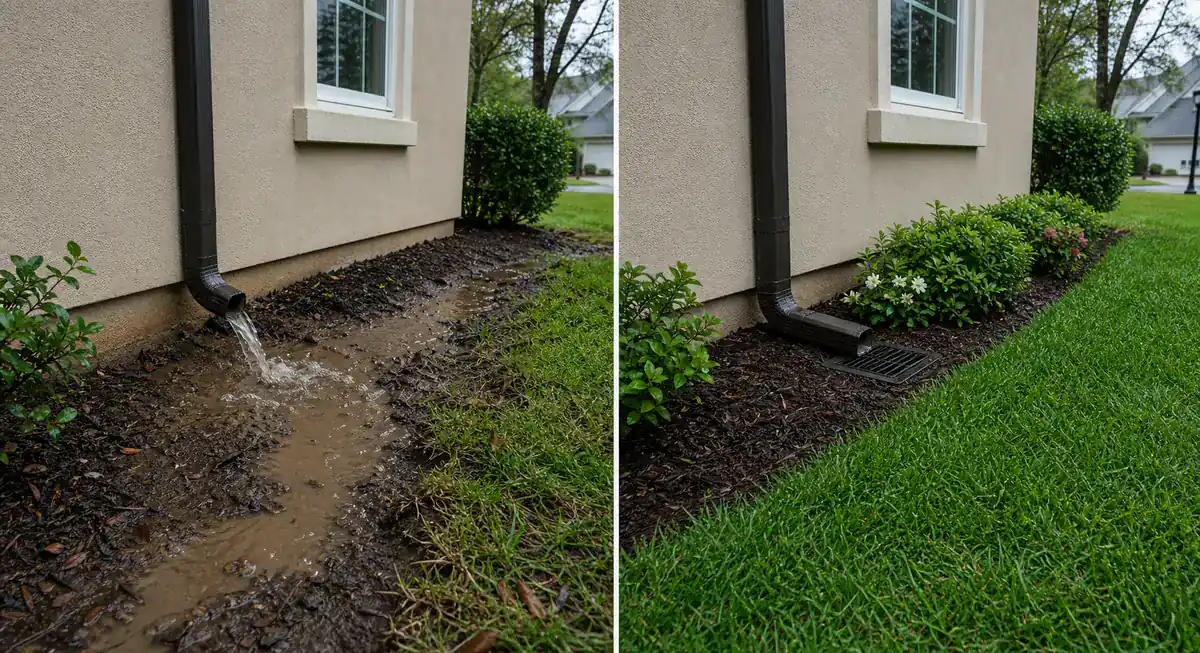
Side-by-side teaching image of downspout runoff pooling beside a home and a corrected collection route in the same landscape bed
A conceptual before-and-after comparison shows why the water source, collection point, and outlet route should be planned together. This is not a Rock Hill project photo.

Use the cheapest plausible correction first

Record where water first appears, the surface path it follows, where it pools, and how long the soil stays saturated after rain. Correct concentrated roof runoff before reshaping a whole yard. Correct broad surface flow before adding a subsurface collector. Reserve deeper excavation for a repeatable wet corridor that remains after simpler sources are controlled. Ask each provider to explain how the proposed collection point and outlet solve the pattern you observed.

Match the behavior before selecting materials

A useful decision separates five patterns.

  • Roof water concentrated at one outlet: extend or convey the downspout first
  • Wide shallow sheeting or ponding across flat ground: compare grading or a swale
  • Water consistently reaching one low point: compare a catch basin and solid outlet pipe
  • A narrow strip that stays soft after surface water leaves: evaluate a French drain
  • No usable gravity outlet: evaluate storage or pumping only after collection volume and discharge are understood

Who to call and what to describe

For water that starts and stays on private property, request a yard-drainage provider and describe the roof outlets, surface-flow direction, exact low points, how long soil remains saturated, and every known discharge option. For runoff in a public street, blocked public inlet, municipal easement, or public stormwater system, contact the responsible Rock Hill or York County office instead of asking a private provider to alter public infrastructure.

Confirm the whole route before comparing quotes

Every option needs a collection point, conveyance route, discharge plan, maintenance access, and restoration scope. A low-cost component does not solve the problem when the outlet is missing or sends concentrated flow toward another property.

Concentrated roof water: route the downspout first

A surface extension or buried solid pipe takes a known source and moves it toward a visible, maintainable outlet. It fits when the wet area begins at one gutter outlet or appears as soon as that outlet flows. HomeGuide publishes $150 to $350 per downspout for buried systems, including bubbler or catch-basin scope. Start here before cutting a broad trench through the lawn.

Compare downspout routing options

Broad surface sheeting: reshape a route

Selective grading changes the surface elevation; a swale forms a wide, shallow path that keeps water moving. These methods fit water spread across flat ground or flowing as a sheet rather than following one saturated strip. The approved cost set has no standalone grading or swale range, so compare soil movement, access, compaction, outlet work, erosion control, and restoration as one earthwork scope.

See how grading and swales redirect surface flow

One low collection point: use a basin and solid pipe

A catch basin places a grated inlet where surrounding grade already delivers surface water. Solid pipe then carries that collected flow to an outlet. It fits a repeatable pool with a clear low point; it fails when water cannot reach the grate or the outlet sits too high. No standalone catch-basin price appears in the approved set, so the cost anchor is the complete inlet, pipe, excavation, discharge, and restoration scope.

Diagnose whether the pool behaves like a collection-point problem

Persistent wet strip: evaluate a French drain

A French drain places a perforated collector in washed aggregate to intercept water moving through saturated soil. It fits a narrow, repeatable wet corridor that remains after roof and broad surface sources are controlled. HomeGuide publishes $10 to $35 per linear foot for shallow exterior yard and curtain drains; Modernize and LawnStarter publish a wider $10 to $65 band where excavation and site complexity rise.

Review French-drain anatomy and installation sequence

No gravity outlet: test storage or pumping assumptions

A dry well stores collected water for gradual infiltration, so clay permeability, available volume, setbacks, and overflow still matter. A sump lifts water to a higher workable discharge when gravity cannot. Modernize publishes $500 to $4,000 for sump systems; Lawn Love lists a $625 to $2,625 French-drain add-on. Neither option creates a lawful discharge by itself.

Review verified outlet and pumping cost factors

Use a diagnostic-first sequence

Watch a rain event from a safe place, identify the first source, test the cheapest plausible correction, and observe the next storm. Move from roof routing to surface reshaping or point collection before subsurface excavation unless the evidence already shows a persistent saturated-soil corridor. This sequence keeps each component tied to a measured behavior.

Reject any option without a complete outlet

Collection is only the first half of a drainage plan. The proposal should state how water moves, where it releases, how that point avoids erosion and concentrated flow onto neighboring property, which parts remain accessible, and what surfaces will be restored. Confirm public-system or property-edge assumptions with the jurisdiction that owns the feature.

Active flooding, water near electrical equipment, sewage, or unstable ground belongs in the urgent yard-drainage safety guide.

Frequently asked questions

When does a catch basin fit?

A catch basin fits a defined low point when surrounding grade can deliver surface water to the grate and solid pipe can carry it to a responsible outlet.

When should a French drain enter the comparison?

Compare a French drain after roof and surface-flow causes have been addressed and a persistent wet strip still indicates water moving through saturated soil.

What if the yard has no gravity outlet?

A dry well may store water for infiltration when soil and setbacks permit. A sump system may lift collected water to a workable discharge; Modernize publishes $500 to $4,000 for sump systems.

Can one yard need more than one method?

Yes. Roof runoff, a surface low point, and saturated soil can overlap, but each component should have a defined job and a shared outlet plan.

How do I request private-yard drainage help?

Share where the water starts, the route it follows, the lowest or softest areas, how long wet conditions last, and any known outlet constraints. Use the contact page to submit those details.

Request delivery: submitting sends your details through Web3Forms. The request may be shared with a local outdoor drainage provider for follow-up. Submission does not guarantee availability, response time, or a quote.

Describe your yard drainage problem

Prefer to call? Call (803) 471-6547.

After submission, Web3Forms displays a confirmation. Submission does not guarantee availability, response time, or a quote.