What does water appearing during rain usually mean?
It usually points toward active surface flow, concentrated roof runoff, or a low point filling faster than it can drain. Trace the first visible source before selecting a correction.
Rock Hill outdoor drainage resource
Water visible during rain usually reveals a surface or roof-runoff route. A lawn that stays soft or refills days later points toward slow clay infiltration, subsurface movement, or seasonal groundwater and needs a different diagnosis.
Editorial review date: July 19, 2026. Pricing and guidance sources were checked for this review.
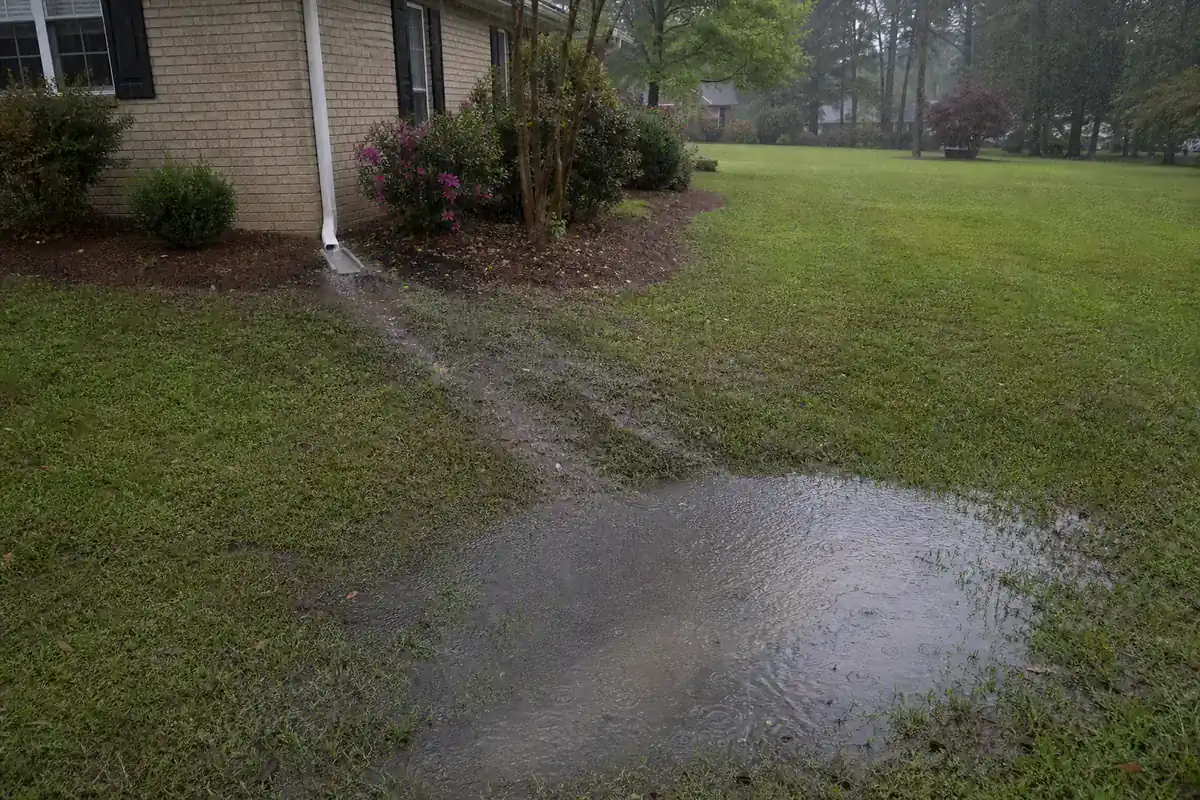
Record whether water appears while rain is falling, immediately after the storm, after visible runoff has stopped, or again without new rain. Fast arrival supports a surface or downspout source. Delayed persistence supports saturated soil or groundwater influence. These observations narrow the next question; they do not establish an engineered diagnosis.
Water beginning against the foundation often traces back to roof discharge or surface grade. A mid-yard pool often marks a collection point. Flow arriving along a property line may involve uphill or neighboring runoff, so document its direction without assuming responsibility or redirecting it across the boundary.
After utilities and private lines are accounted for, a safely placed test hole that continues holding water for days suggests clay-limited infiltration or already saturated soil. It does not measure system capacity, prove a high water table, or replace elevation and soil review.
From a safe location, note the first place water appears, whether it moves as a sheet or a narrow stream, when the pool reaches its widest edge, when visible water disappears, and when the soil becomes firm again. Repeat the same observations after another storm. A repeatable timeline carries more diagnostic value than one dry-day photograph.
Water that tracks a downspout discharge or crosses the grass during rainfall behaves like concentrated or broad surface runoff. A wet strip that remains after those visible routes stop suggests water moving through slowly draining soil. Water that returns without new rain can involve seasonal groundwater. Record the behavior and leave final classification to site review.
Clemson Extension explains that clay holds moisture longer than sandy soil. In a Rock Hill low spot, compacted clay can slow infiltration and keep the surface soft after runoff ends. Clay context explains persistence; timing, elevation, and source observations still decide the next investigation.
When the first wet point sits below a gutter outlet and grows as that outlet flows, evaluate the roof-water route before broader yard work.
When shallow water crosses a wide area or follows a reverse surface slope, compare selective regrading or a swale rather than subsurface construction details.
When a narrow strip remains saturated after roof and surface sources are controlled, evaluate whether a subsurface interceptor has a defined collection job and outlet.
Describe the source, timing, route, low point, soil persistence, property-edge flow, and likely outlet before asking for a method or price. A quote that starts with pipe length before explaining the observed pattern has skipped the diagnostic step.
It usually points toward active surface flow, concentrated roof runoff, or a low point filling faster than it can drain. Trace the first visible source before selecting a correction.
Persistent softness can indicate slow clay infiltration or water moving through saturated soil. Compare the wet corridor across more than one storm.
A defined pool may support a catch basin when the surrounding grade feeds one collection point and solid pipe can reach a responsible outlet.
Document the direction and confirm the property and drainage context first. A correction should avoid concentrating flow onto another property or public area.
No. It is one observation. Source timing, elevations, soil, outlet conditions, and repeatability still determine whether subsurface collection fits.
Request delivery: submitting sends your details through Web3Forms. The request may be shared with a local outdoor drainage provider for follow-up. Submission does not guarantee availability, response time, or a quote.
Prefer to call? Call (803) 471-6547.