Rock Hill outdoor drainage resource

Rock Hill Yard Drainage Cost Guide

Yard drainage pricing combines a per-linear-foot installation cost with fixed work such as basins, outlet construction, aggregate delivery, utility conflicts, and lawn or hardscape restoration. Those fixed costs explain why a short drain can carry a high effective price per foot.

Editorial review date: July 19, 2026. Pricing and guidance sources were checked for this review.

Independent lead-generation website. We do not perform contractor services. Read terms and service limits.
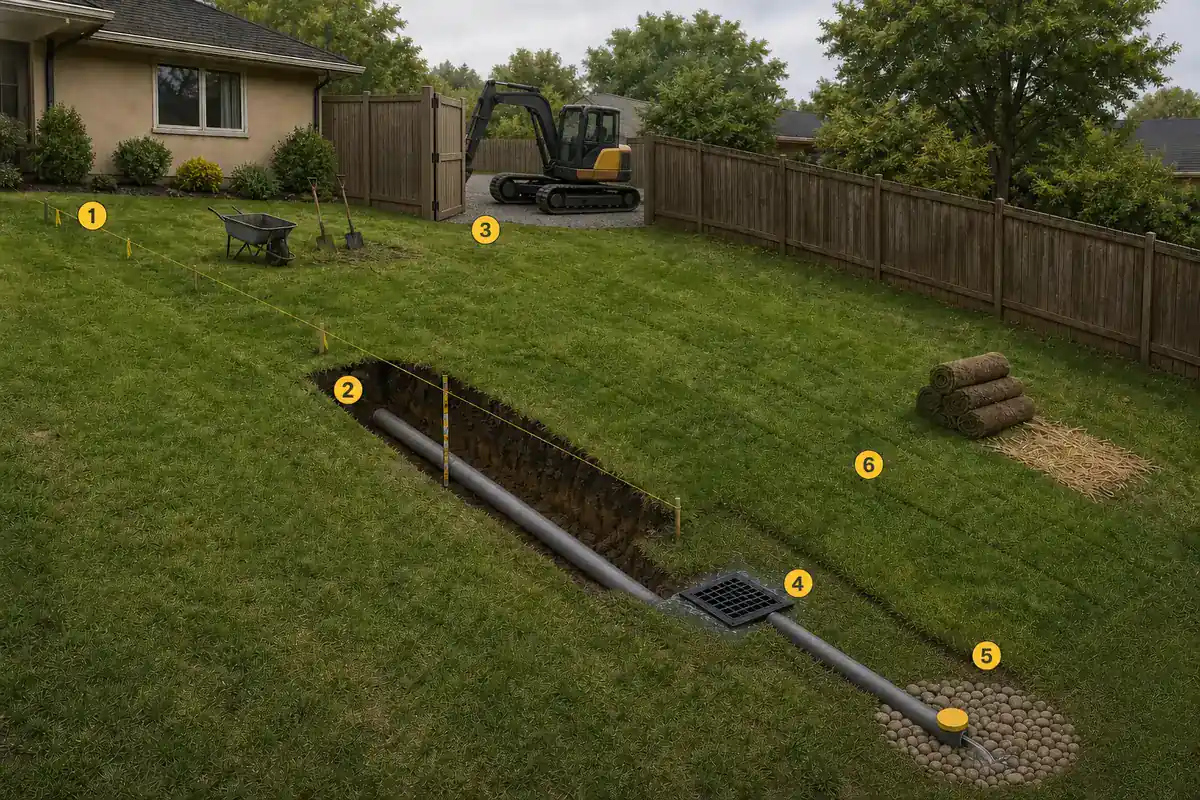
Illustration of a drainage route with excavation, machine access, collection basin, outlet work, and lawn restoration markers
Illustrative scope factors include route length, excavation, access, collection points, outlet work, and restoration. This is not a site-specific design.

What outdoor French drains cost

HomeGuide places shallow exterior yard and curtain French drains at $10 to $35 per linear foot. Its drainage-system guide gives $1,000 to $4,000 for around-the-house exterior yard and curtain systems, while its broader French-drain guide spans $500 to $8,800 for exterior yard or curtain projects. These are national planning ranges, not Rock Hill averages or a promise of local pricing.

Use the wider exterior range for complex yards

Modernize and LawnStarter each publish a wider $10 to $65 per-linear-foot band for exterior French drains. Modernize translates that range to about $1,000 to $6,500 for a 100-foot outdoor run, including materials, labor, and excavation. Deep cuts, difficult access, clay excavation, constructed outlets, and heavy restoration can push a quote toward the upper end.

Fixed costs change the total

The trench cannot be priced in isolation. A gravity outlet may need erosion protection or a connection point. A yard without workable fall may need a sump pump system; Modernize publishes $500 to $4,000, while Lawn Love lists a $625 to $2,625 French-drain add-on. Basins, dry wells, spoil removal, aggregate delivery, sod, planting, paving, and cleanouts also add costs that do not scale neatly with trench length.

Other drain types are different scopes

HomeGuide prices trench or channel drains for driveways and other hard surfaces at $30 to $150 per linear foot. It places interior basement perimeter drains at $40 to $85 per linear foot and $4,000 to $17,000 installed. That interior figure appears only to prevent a bad comparison: this site covers outdoor yard drainage, where excavation, discharge, and restoration follow a different scope.

Start with the cheapest plausible correction

Check concentrated roof runoff before assuming the yard needs a French drain. HomeGuide publishes $150 to $350 per downspout for a buried downspout system; a visible extension or another simple surface correction often costs only a few hundred dollars and may remove the water source before a larger trench is considered.

Why quotes for “the same job” can vary three to five times

A $1,800 proposal and a $9,000 proposal can use the same broad project label while pricing different finished systems. One may cover a shallow surface collector with an easy daylight outlet. The other may include deeper excavation, multiple basins, perforated pipe in washed aggregate and filter fabric, solid conveyance pipe, a dry well or pumped discharge, spoil removal, and full lawn restoration. Compare collection points, depth, materials, outlet, access, utility precautions, disposal, and restoration. A low trench price that omits the outlet or lawn repair does not describe the same result.

  • Drain type and whether it collects surface flow or saturated-soil movement
  • Excavation depth, width, hand-digging, machine access, and removed soil
  • Where collected water goes: daylight, dry well, approved connection, or pumped outlet
  • Catch basins, cleanouts, erosion protection, and future maintenance access
  • Sod, seed, planting, edging, concrete, pavers, or driveway restoration
Why Rock Hill clay changes the work

Rock Hill lies in South Carolina’s Piedmont, where reddish clay-rich subsoil is common. Clemson Extension notes that clay holds moisture longer than sandy soil. Once a compacted or low area becomes saturated, moving roof water across the surface may help without drying a persistent wet corridor. That is where subsurface collection can earn its higher excavation and aggregate cost, provided the design still has a responsible outlet.

SC811 and private lines affect route and price

A French-drain trench counts as excavation. South Carolina law requires notice to SC811 before digging, and SC811 says the person or company doing the excavation should submit the locate request. Standard utility marking generally stops at the meter or utility-owned facilities. Irrigation, septic lines, landscape lighting, and other private installations may need records, owner marking, or a private locator. A conflict can force hand digging, a deeper review, or a new route, so it belongs in the estimate rather than in a surprise change order.

Price the discharge before pricing the trench

Collection solves only half of the problem. The proposal should identify where the water can lawfully and safely leave, whether the outlet remains accessible, and how it avoids erosion or transferring concentrated flow to neighboring property or a street. The City of Rock Hill manages a regulated municipal stormwater system, and York County administers stormwater and sediment controls in unincorporated areas. Confirm the property jurisdiction and local requirements before treating a street inlet, ditch, public system, or property edge as an available outlet.

The honest DIY cost comparison

HomeGuide lists a do-it-yourself drain at $4 to $8 per linear foot for tools and materials. Lawn Love’s itemized 25-foot example totals about $528, or roughly $21 per foot, after tools and equipment enter the list. That lands inside published professional per-foot ranges before aggregate delivery, disposal, private-line locating, lawn repair, and the value of the labor are counted. DIY drain work does not reliably save money, and a mis-sloped trench can hold water or send it toward a worse location.

Questions that make estimates easier to compare

Ask each provider to identify the diagnosed water source, explain why the proposed method fits, describe the discharge route, list excluded restoration, and state how the system can be maintained. Photos help with preparation, but elevations, soil, access, buried conflicts, and outlet conditions still require site review.

  • What water source is the system intended to manage?
  • What collection and discharge points are included?
  • Who handles utility marking and private-line identification?
  • Which surfaces will be restored, and to what condition?
  • How can the system be inspected or cleaned later?

What to provide for a useful estimate

Prepare rain-event timing, photos kept for later sharing, the apparent source, pool duration, route access, known utilities or irrigation, previous work, and the surfaces that need restoration. These details help a provider compare methods and identify what still requires an on-site elevation or outlet check.

What happens after submitting the form

The request is submitted through Web3Forms and may be shared with a local outdoor drainage provider for follow-up. Submitting this form is a request, not a booking. It does not guarantee an estimate, a response time, or provider availability.

Frequently asked questions

What does a French drain cost in Rock Hill?

For planning, HomeGuide publishes $10 to $35 per linear foot for a shallow exterior yard or curtain French drain and $1,000 to $4,000 for a typical around-the-house exterior system. These are national ranges rather than Rock Hill averages. The local quote still depends on depth, access, outlet construction, clay excavation, and restoration.

Why do yard-drainage quotes vary so much?

Quotes may price different drain depths, collection points, outlets, excavation access, utility conflicts, and restoration. A surface route to daylight does not carry the same scope as a deeper collector feeding a dry well or pumped outlet. Compare every included and excluded item before comparing totals.

Is a DIY French drain cheaper?

Not reliably. HomeGuide estimates a do-it-yourself drain at $4 to $8 per linear foot for tools and materials, while Lawn Love itemized a 25-foot project at about $528, or roughly $21 per foot, after tools and equipment. Aggregate delivery, rentals, private-line locating, restoration, and correction of a bad slope can erase the apparent savings.

Do I need to contact SC811 before digging?

Yes. South Carolina law requires notice before excavation, and SC811 says the person or company performing the digging should submit the locate request. Standard marking does not cover every private line, so irrigation, septic, landscape-lighting, and other owner-installed lines need separate identification.

What is the cheapest yard-drainage fix to check first?

Start with gutters and downspout routing when roof water feeds the wet area. A visible extension or another simple surface correction often costs a few hundred dollars and can make a larger drain unnecessary when the downspout is the actual source.

Request delivery: submitting sends your details through Web3Forms. The request may be shared with a local outdoor drainage provider for follow-up. Submission does not guarantee availability, response time, or a quote.

Describe your yard drainage problem

Prefer to call? Call (803) 471-6547.

After submission, Web3Forms displays a confirmation. Submission does not guarantee availability, response time, or a quote.