What is the cheapest downspout correction?
A properly placed splash block or visible extension is the simplest first comparison when it can move water toward a stable outlet without creating a trip or mowing problem.
Rock Hill outdoor drainage resource
HomeGuide publishes $150 to $350 per downspout for buried drainage systems. That relatively contained correction deserves the first look when pooling begins at a gutter outlet, because roof water concentrates at only a few discharge points.
Editorial review date: July 19, 2026. Pricing and guidance sources were checked for this review.
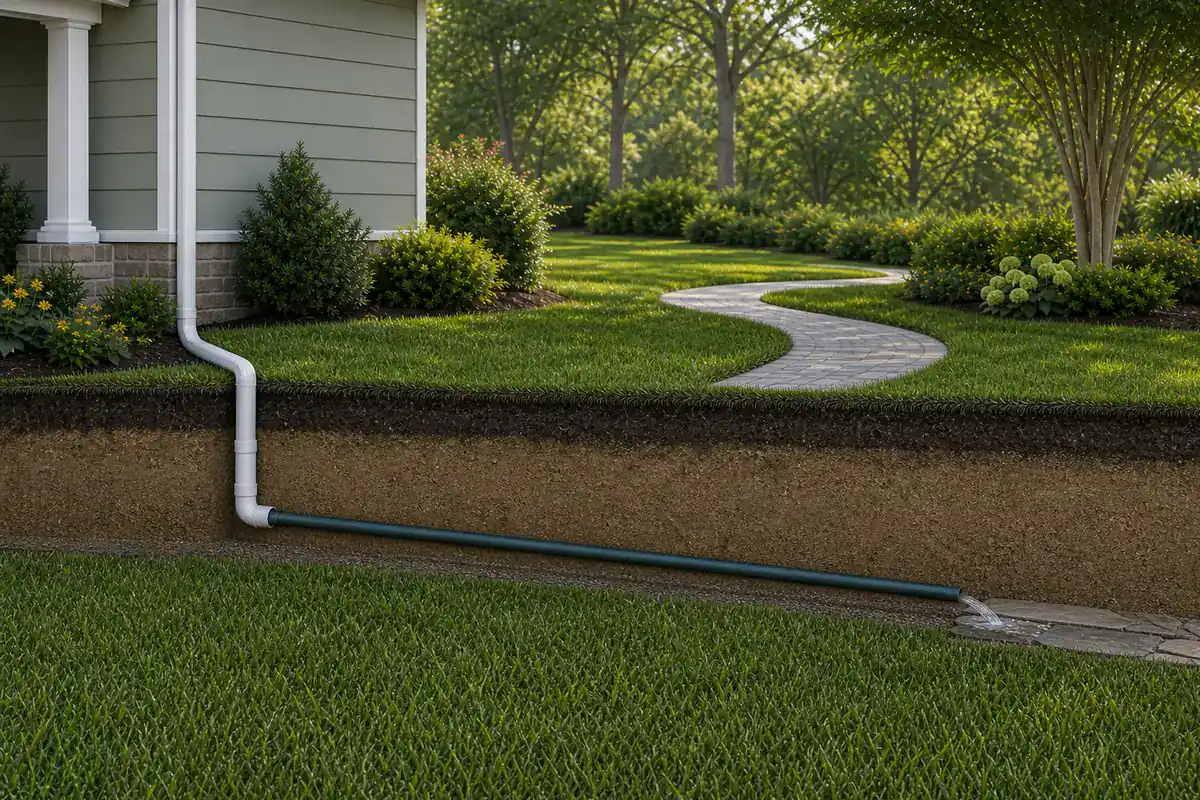
A splash block controls the immediate splash zone. A surface extension moves the outlet farther while staying easy to inspect. Buried solid pipe conceals a longer route and may terminate at a pop-up emitter or a suitable open outlet. A larger conveyance line can combine multiple roof leaders only when pipe capacity, cleanout access, elevations, and discharge are designed together.
HomeGuide’s $150 to $350 per-downspout range describes buried downspout drainage that may use underground extensions leading to bubbler pots or catch basins. Route length, excavation, fittings, cleanouts, outlet protection, hardscape crossings, and restoration can make a larger conveyance project a different scope.
Downspout work alone may be enough when the wet strip begins directly below one outlet, appears as that outlet flows, and stops returning after the roof-water route is corrected. Persistent mid-yard saturation after that correction belongs in the diagnosis lane.
Inspect from the ground during rain: note gutter overflow, leaking elbows, disconnected fittings, crushed extensions, and the exact point where the downspout releases. Then follow the surface route to the wet area. A sound buried line cannot correct an overflowing gutter or a blocked inlet above it.
A downspout adapter feeds solid conveyance pipe so concentrated roof water stays inside the route. Cleanouts or accessible fittings belong where debris can collect and where direction changes. A pop-up emitter opens under flow at the low end; it still needs positive fall and a surface that can accept the release.
The endpoint should not send water back toward the foundation, across a walking route, onto neighboring property, or into an assumed public connection. Rock Hill notes that its storm drains discharge to waterways, so the route also needs erosion and pollutant control. Confirm ownership and local requirements before using a ditch, inlet, or street edge.
SC811 directs homeowners to request marking before any digging and explains that private lines are outside standard public-utility marking. A short downspout trench can still cross irrigation, lighting, or other owner-installed utilities, so settle the route only after those conflicts are identified.
Gutters, strainers, downspout elbows, adapters, cleanouts, and emitters can gather leaves and grit. The design should allow inspection without digging and should keep the outlet visible enough to spot erosion, animal blockage, or a stuck emitter after storms.
Identify each contributing downspout, the solid-pipe route, cleanout points, outlet type, utility conflicts, hardscape crossings, erosion protection, and restoration. Submitting this form is a request, not a booking. It does not guarantee an estimate, a response time, or provider availability.
A properly placed splash block or visible extension is the simplest first comparison when it can move water toward a stable outlet without creating a trip or mowing problem.
HomeGuide publishes $150 to $350 per downspout for buried systems. Treat that as a national planning range and compare the full route and restoration.
Solid pipe keeps concentrated roof water inside the conveyance route. Perforated pipe exchanges water with surrounding soil and serves a different collection job.
Yes, when the line has workable fall and the emitter can release water without erosion, blockage, unsafe surface flow, or transfer to neighboring property.
Sometimes, but the combined roof area, pipe capacity, cleanout access, slope, and outlet must support the added flow.
Request delivery: submitting sends your details through Web3Forms. The request may be shared with a local outdoor drainage provider for follow-up. Submission does not guarantee availability, response time, or a quote.
Prefer to call? Call (803) 471-6547.